
Game field guide / The idea behind your actions
A world that
remembers your care.
Store of Vibe is one playable expression of a much bigger idea.
Read the full Arcade.fun manifestoThe person before the number.
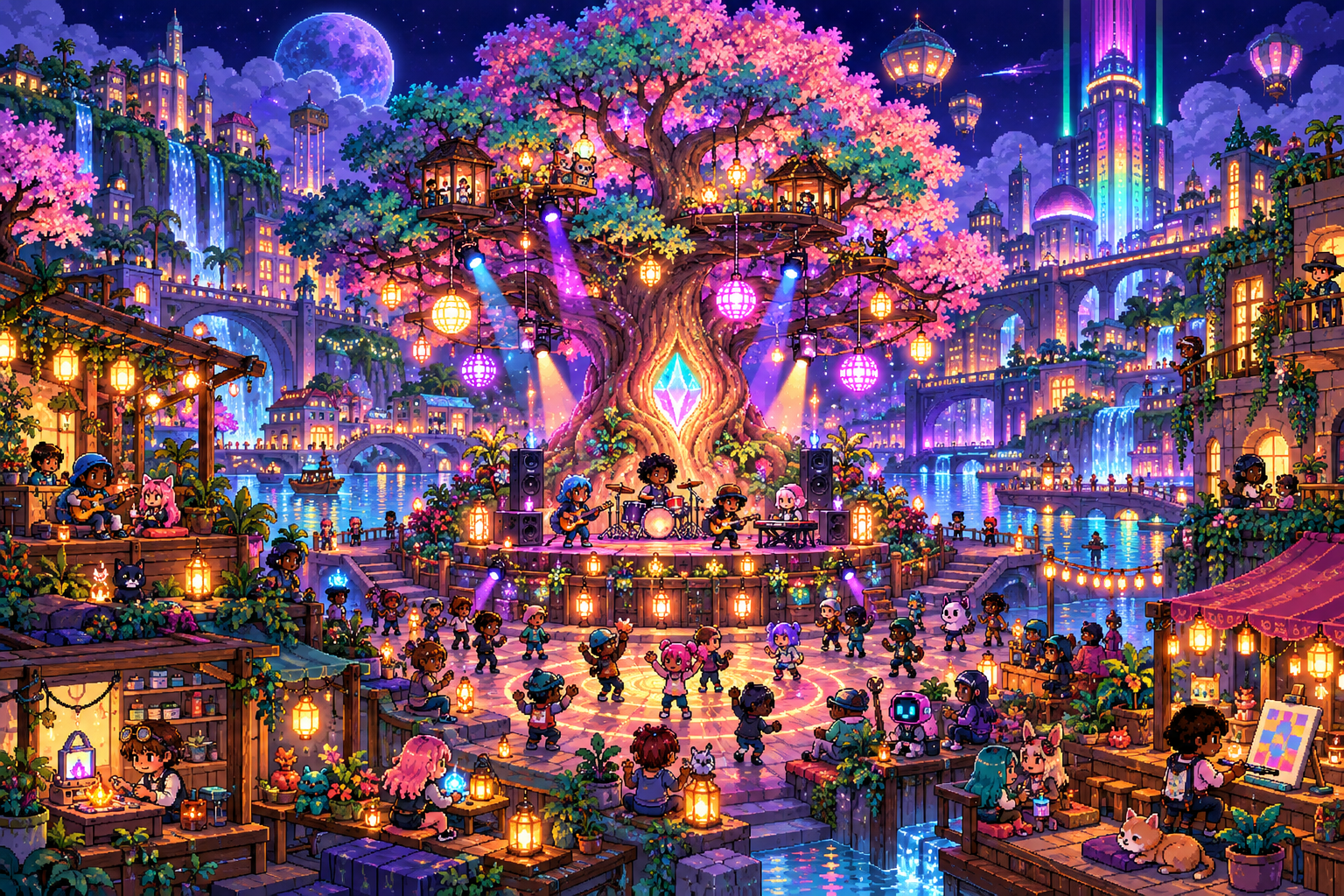
The story starts with Nova because value starts with a reason to care. Sparks scattered across the plaza are material. A Sound Garden gives them a purpose. Nova gives that purpose a human face. You can see what your effort makes possible for someone else.
Pip, Byte and Echo each bring a different kind of life into the city. The game asks you to notice those differences. A commons becomes richer when its people can contribute different things and find places where those contributions matter.
Use the market.
Notice the purpose.
The early exchange is useful: trade, collect credits, switch on a public light. The consequence is visible. You did not simply improve your balance; you made the plaza easier for everyone to inhabit.
Then hype interrupts that relationship. Copies multiply. Bots chase attention. The Price Machine tries to make its own number the objective. Reconnecting the venues is your way of giving the makers their city back.
Break the measure.
Keep the meaning.
The boss fight puts the makers’ venues to work together. You open the core by coordinating around the places you helped restore. When the machine breaks, the price reaches zero while those places and relationships remain.
This is the story’s turning point. The market can help a community coordinate, but it cannot contain everything that makes a world valuable. A store of vibe holds the conditions for shared life to keep happening: places, memories, creative possibilities and people choosing to return.
Winning opens
another beginning.
The festival is something you actively make. Gifts reach the dance floor. Every venue contributes its beat. The win belongs to a connected world, and completing the solo story opens a persistent online commons.
There, the question becomes collective. What will we contribute? What should grow next? What will the next player find because we were here? A lasting shared project gives your actions consequences beyond a solo run.
The game’s credits and resources are fictional. Its bigger invitation is real: build something people appreciate together. The Arcade.fun manifesto follows that invitation into mass tastemaking, evolving games that are markets, the agent world, and a future built for planetary and human flourishing.
Three signals. A different game.
The source stack.
These ideas meet here. The world we build from them is our own.
Desire moves between people.
In Peter Thiel’s conversation with Walter Isaacson on The Builders, imitation can transmit culture and also trap us in sterile status competitions. Relationships remain central to human flourishing. Our design question: can the game turn that social energy toward building something together?
Abundance moves the bottleneck.
Alex Imas’s “What will be scarce?” argues that automation can shift demand toward goods whose human involvement, provenance and relational meaning are part of their value. Our extension: abundant creation makes shared attention, care and lived context more important design materials.
Culture coordinates action.
In “The Memecoin Supercycle: Two Years Later,” Murad describes people concentrating money, labor and attention around ideas and identity. We carry that coordination insight into play, then challenge the dependence on a financial chart. A shared symbol becomes more interesting when it opens a shared world.