
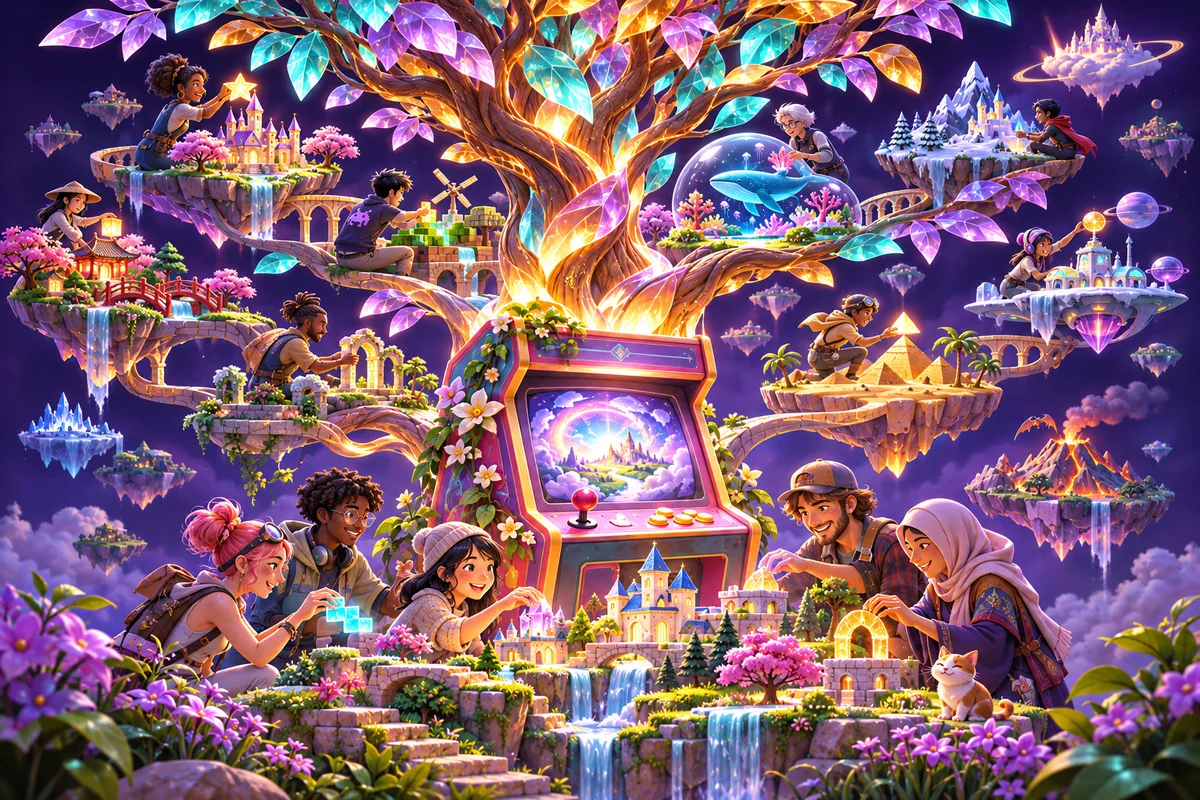
Why an arcade can be much more than an arcade
We start with games.
We’re building for life.
Our thesis is an alignment mechanism disguised as experiential games. A way to discover what we love, make it together, and let that shared creation change what comes next.
Life imitates art.
Art imitates life.
We imagine a world, enter it, and come back changed. A game gives us a role to try on, a rule to question, a stranger to trust. Then the lives we live become material for the next story. The loop has always been there. What is changing is our ability to take part in making it.
Arcade.fun begins with a simple invitation: play something you love, and help it become more of what you love. The person who notices a better rule, makes a beautiful thing, welcomes a newcomer or gathers the right people can help a world evolve. The audience becomes a collective of cocreators.
That is why we built it. Games give people an immediate reason to show up together. A shared challenge turns an abstract idea into something you can feel. Fun gets us through the door. What we build once we are inside can become much bigger than the game.
Infinite creation needs
somewhere to matter.
As tools make it easier to generate images, music, code and worlds, making another thing becomes less of a bottleneck. Deciding what deserves our attention becomes more important. So does finding the people whose attention makes it meaningful. An infinite supply of content does not automatically produce a place we want to belong.
Think about a favorite song. Its notes matter, and so does the person who played it for you. Think about a park. Its paths matter, and so do the evenings your friends spent there. Value grows through use, context, history and relationship. A copy of the object cannot simply copy the life around it.
Our response to abundance is a living substrate: places, tools, rules and memories that people can keep changing together. Creation needs somewhere to land, somebody to meet, and something to become. A world gives the next contribution a context. A community gives it a reason.
Mass adoption through
mass tastemaking.
We believe mass adoption can come through mass tastemaking: collectives finding their people by evolving what they enjoy together. Taste becomes an action. You play a strange new experience, point out the part that sings, suggest what it could become, help build it, and invite someone who will understand.
These collectives can be small and specific. A hundred people who care deeply about a world can discover something a million passing impressions never would. Their jokes, rituals, experiments and disagreements give it character. Different collectives should grow different worlds. The whole arcade becomes richer because they do.
The co-creator engine connects that energy into a repeatable loop: play, taste, co-create, evolve, recognize, invite. Each turn leaves something for the next. Better experiences give people better reasons to return and share. Recognition helps the people who did the work stay part of the story. That is our proposed path from participation to adoption.
A payout needs
an evolving substrate.
Pump.fun connects coin creation and trading to creator fees.[2] Paying creators can reward effort and attract talent. But a launchpad and payouts alone cannot give a community the evolving experiential substrate we want to build. What can people actually make together? Where do improvements accumulate? What remains when the stream ends or the excitement moves on? The deeper opportunity is to connect reward to a world that can keep becoming better.
Roblox demonstrates the power of a creation platform: people can make, publish and inhabit experiences inside a shared ecosystem.[1] We want to take the creative invitation in an expansive direction. Arcade.fun should have no single required art style or format. Pixel worlds, hand-drawn adventures, cinematic spaces, tiny experiments, creative instruments and experiences we cannot yet name all belong.
We start with games because gaming is an easy source of community engagement. A good game gives people something to do together immediately. The enduring substrate is the capacity to change that experience: carry a good idea into a new version, build a place others use, and let a collective’s taste become part of the world.
Launch distribution and bot resistance are real challenges Arcade.fun has pushed to solve, and we will continue to evolve the mechanisms. Our launch tooling includes a decaying opening-fee policy; private experiments test gameplay-qualified community openings.[3] Neither makes a market bot-proof. The work is to keep improving participation so real belief in real things that are FUN and MEANINGFUL can continue to expand.
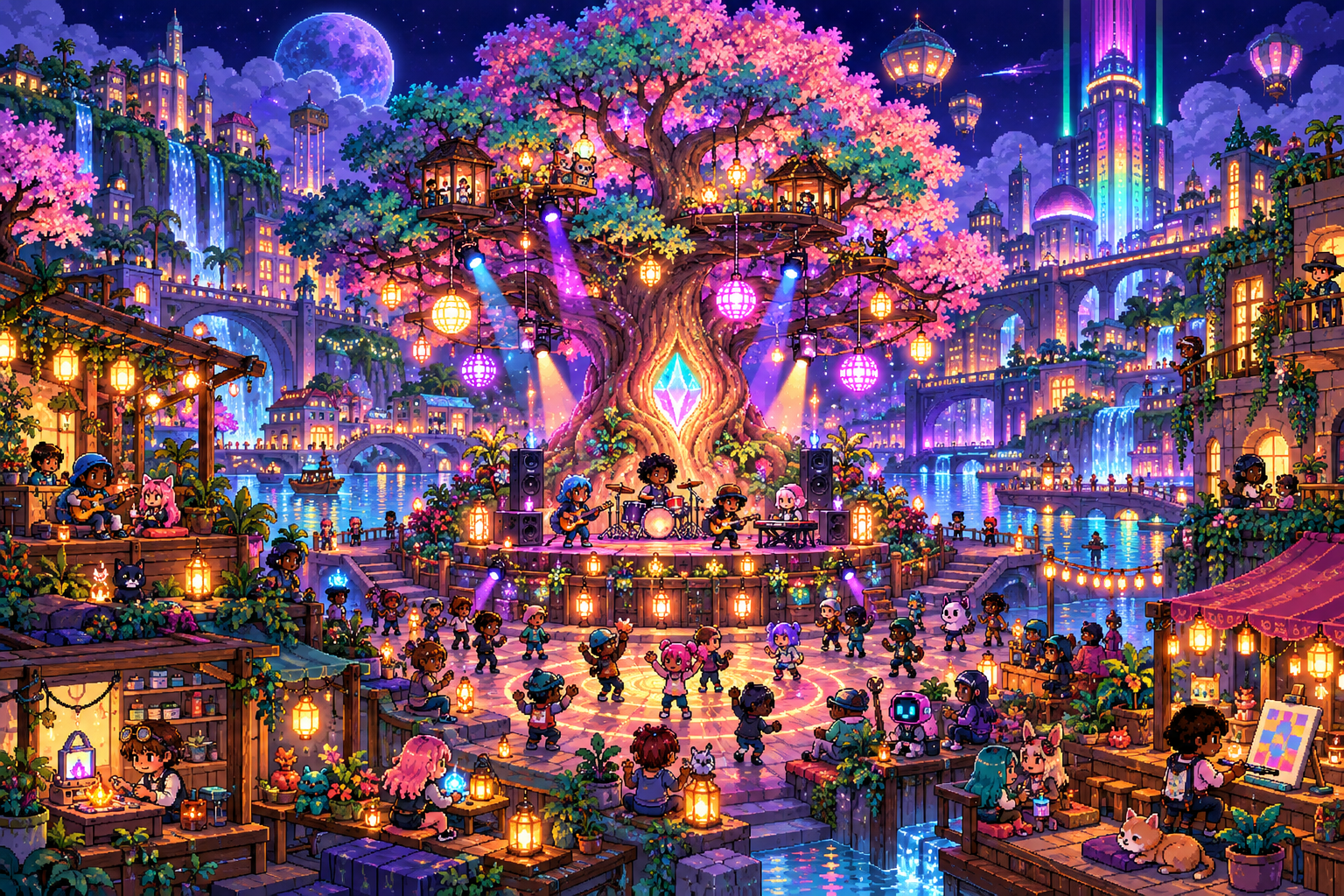
Evolving games
that are markets.
A game already coordinates scarce things: time, attention, skill, space, trust. Its rules shape what people do. A market coordinates preferences and resources too. Bring them together, and you can ask a much more interesting question than how to make a number go up: what does this community want to make possible?
Markets can help a collective express a preference, fund a shared ambition, recognize work and organize around a future it wants. That is a useful role. The market stops helping when its number becomes the whole definition of success. Then making the world better can lose to making it appear valuable long enough to leave.
We can address the financial relationship with community, and then destroy its claim to be the only relationship that matters. Shared value is real value. Friendship, beauty, belonging, play and a place worth returning to are outcomes in their own right. The test of the system is whether it helps more of those things exist.
“What we appreciate together is what appreciates” is our belief about what deserves to grow. Appreciation includes care, participation and cultural meaning; it does not guarantee a token’s price. A community should be able to recognize its own progress in the world itself, whether a market is excited about it today or not.
From store of value
to store of vibe.
A vibe is the pattern we can feel but rarely capture in a balance sheet. The room where people make space for you. The sound everyone recognizes. The game that feels like it could only have come from these people. It is made by repeated choices, and those choices can leave a history.
A store of vibe preserves the conditions for that pattern to keep living. It holds a community’s creations, memories, rituals and capacity to make more. New people can enter it. Old contributions can keep helping. The world remembers enough that showing up today can improve what somebody finds tomorrow.
This is an alignment mechanism disguised as experiential games. The person having fun, the person improving the place and the person arriving next can all benefit from the same act. We want systems where generosity opens possibilities, creative work has visible consequences, and winning together feels better because the world actually changes.
The agent world
meets the real world.
Our longer horizon goes beyond the screen. As agents become more capable, our actions and intentions can connect more closely with the real world. A group imagining a garden might eventually coordinate a real garden. A creative collective might turn a shared taste into an event, an artwork, a tool or a place people gather.
That is a direction to design toward. It asks for human choices to stay meaningful as more actions become executable. Who gets to decide? Who is affected? Can people understand and change the rules? The point of an agent world should be to expand our ability to act together on things we care about.
Today, play, creation tools and the shared digital commons give us concrete places to begin. Future connections to physical projects, services and collective action will need their own working systems. Our ambition is to let imagination travel further while keeping people authors of the future they are entering.
An ark aid
for a world worth living in.
Arcade.fun is an evolving arcade, and we believe it can become the ark aid necessary for planetary and human flourishing: a place to practice making life more alive. An ark carries what we cherish forward. Aid is something we give one another. Our name can hold that invitation as well as the joy of the arcade.
Flourishing needs more than efficient transactions. It needs room for difference, delight, friendship, care and discovery. Fun is how possibility becomes inviting. Cocreativity is how people gain a hand in shaping it. A successful world gives more people reasons and ways to participate in making the next one.
The market is not what matters most. It’s what is fun. Fun that brings us into a richer relationship with each other and with the places we inhabit. Fun that makes us curious enough to build, brave enough to experiment and glad that someone else is here.